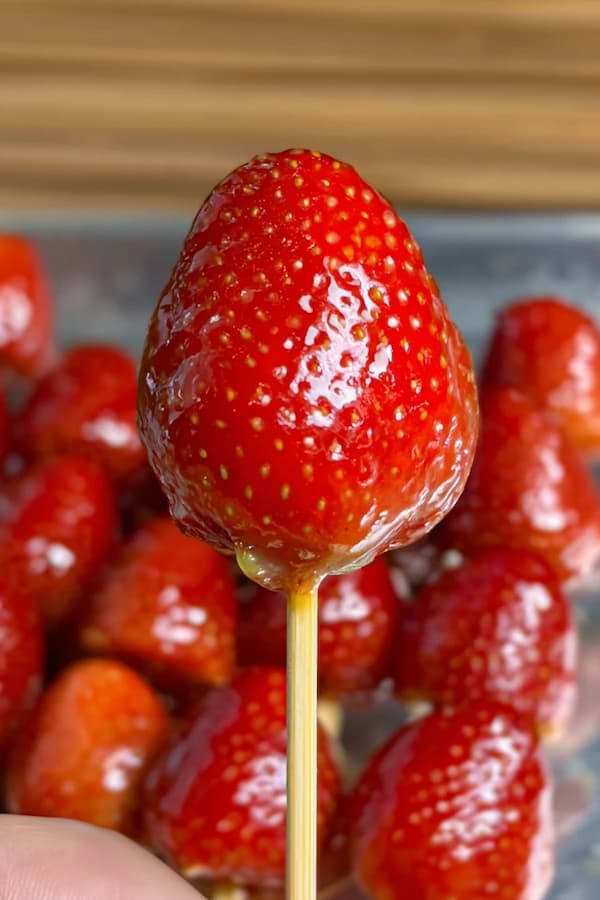
Tanghulu is a traditional Chinese street food that has become a viral sensation because of its glass-like sugar coating and satisfying crunch.
The process involves dipping fresh fruit into a hot sugar syrup that hardens instantly into a shiny, crackling shell.
It is a simple treat to make at home, but it requires a bit of patience and careful attention to temperature to get that perfect “snap.”
Ingredients
This recipe makes 4 servings, which is about 8 to 10 fruit skewers depending on how many pieces of fruit you put on each stick.
- 2 cups granulated white sugar
- 1 cup water
- 1 pound fresh strawberries (or grapes, tangerine segments, or kiwi)
- 10 bamboo skewers
- 1 bowl of ice water (for testing)
The Fruit
The secret to a top-notch Tanghulu starts with the preparation of your fruit. While strawberries are the most popular choice, you can use almost any fruit with a firm skin. The absolute most important rule is that your fruit must be bone-dry.
If there is even a single drop of water on the surface of the strawberry, the sugar syrup will not stick. It will simply slide off, leaving you with a sticky mess instead of a glass coating.
I recommend washing your fruit at least an hour before you plan to start. Pat every piece dry with a paper towel and let them sit on the counter to air dry completely. If you are using strawberries, leave the green leaves on if possible; they act as a little handle and keep the juice inside the berry. If you cut the fruit, the juice will leak out and dissolve the sugar shell from the inside out.
Skewer Work
Thread your dry fruit onto the bamboo skewers. For strawberries, I usually put two or three on a stick. For smaller fruits like grapes or blueberries, you can add four or five. Make sure the fruit is snug against each other but not crushed. Once the fruit is on the sticks, set them aside on a piece of parchment paper. This is your last chance to check for any moisture on the skin.
Sugar Heat
In a small, deep saucepan, combine the sugar and the water. Stir them together just once to make sure the sugar is wet, then turn the heat to medium-high. Once the heat is on, do not stir the mixture again.
Stirring causes the sugar to crystallize, which will turn your syrup into a grainy, cloudy paste instead of a clear, see-through glass. Just let the bubbles do the work.
Bubble Watch
The syrup needs to reach the “hard crack” stage. If you have a candy thermometer, you are looking for exactly 300 degrees Fahrenheit (which is 150 degrees Celsius). If you do not have a thermometer, simply watch the bubbles. They will start out large and move fast. As the water evaporates, the bubbles will become smaller, slower, and much thicker. The syrup will eventually take on a very slight golden color. This is the sign that the sugar is ready to harden.
They will start out large and fast, but as the water evaporates, they will become smaller, slower, and thicker. The syrup will eventually take on a very slight golden tint.
Cold Test
If you aren’t using a thermometer, use the ice water test. Dip a spare skewer or a spoon into the boiling syrup and immediately drop it into the bowl of ice water. Wait five seconds and then bite it or tap it against the side of the bowl.
If it is soft or sticks to your teeth, it isn’t ready. If it cracks instantly with a loud “snap,” you are ready to dip.
Quick Dip
Tilt your saucepan so the syrup pools on one side. Take a fruit skewer and rotate it quickly in the syrup. You want a very thin, even layer.
Do not leave the fruit in the hot sugar for more than a second or two, or you will end up cooking the fruit and making it mushy. Speed is the key here. The goal is a delicate shell, not a thick brick of candy.
Instant Set
Immediately place the dipped skewer onto a baking sheet lined with parchment paper or a silicone mat. Because the syrup was at the hard crack stage, it should begin to set almost instantly.
Within a minute, you should be able to tap the fruit and hear a clicking sound. Repeat the process with the rest of your skewers until all the fruit is coated.
Better Snap
To get a “top-notch” result, focus on the thickness of the shell. A common mistake is thinking more sugar is better. In reality, the best Tanghulu has a shell so thin you can barely see it. A thin shell is easy to bite through and allows the tartness of the fruit to shine. If the layer is too thick, it can be hard on your teeth and overwhelm the flavor of the strawberry.
Another tip is to work in small batches. If you have twenty skewers to dip, the sugar in the pot will continue to cook and eventually burn while you are working. If the syrup starts to turn a dark amber color, it will taste bitter.
You are better off making two small batches of syrup than trying to rush through one giant pot.
Common Pitfalls
The biggest mistake is the “Stirring Sin.” It is very tempting to stir the pot when the sugar starts to boil, but you must resist. If crystals form on the side of the pot, they will trigger a chain reaction that turns the whole batch into a sandy mess.
If you see crystals forming on the sides, you can use a wet pastry brush to gently wash them down into the syrup, but never stick a spoon in there to stir.
Another issue is humidity. If you are making Tanghulu on a very rainy or humid day, the sugar may absorb moisture from the air and become sticky within minutes. This treat is best made in a cool, dry kitchen.
If the candy starts to feel tacky, you can try putting the finished skewers in the fridge for a few minutes, but they are truly meant to be eaten immediately.
Can I Use Frozen Fruit For This Recipe?
You should definitely avoid using frozen fruit for Tanghulu. As frozen fruit thaws, it releases a significant amount of moisture and condensation on the surface. As we discussed earlier, moisture is the enemy of sugar syrup.
The water will prevent the sugar from bonding to the fruit, and the shell will slide off in a sticky puddle. Stick to fresh, firm, and room-temperature fruit for the best results.
Why Is My Tanghulu Sticky Instead Of Crunchy?
If your sugar coating stays sticky or chewy, it means the syrup did not reach a high enough temperature. Sugar goes through different stages as it boils. If you stop the heat too early, you get a texture like caramel or taffy.
You must hit that 300-degree mark to ensure the water is fully evaporated. This is the only way the sugar can form a brittle, glass-like structure. If it does not snap when you test it in the ice water, it will not snap on the fruit.
Ingredients
Method
- While strawberries are the most popular choice, you can use almost any fruit with a firm skin. The absolute most important rule is that your fruit must be bone-dry.
- I recommend washing your fruit at least an hour before you plan to start. Pat every piece dry with a paper towel and let them sit on the counter to air dry completely.
- Thread your dry fruit onto the bamboo skewers. For strawberries, I usually put two or three on a stick. For smaller fruits like grapes or blueberries, you can add four or five. Make sure the fruit is snug against each other but not crushed.
- In a small, deep saucepan, combine the sugar and the water. Stir them together just once to make sure the sugar is wet, then turn the heat to medium-high. Once the heat is on, do not stir the mixture again. Just let the bubbles do the work.
- If you have a candy thermometer, you are looking for exactly 300 degrees Fahrenheit (which is 150 degrees Celsius). If you do not have a thermometer, simply watch the bubbles. If you do not have a thermometer, simply watch the bubbles. They will start out large and move fast. As the water evaporates, the bubbles will become smaller, slower, and much thicker.
- Tilt your saucepan so the syrup pools on one side. Take a fruit skewer and rotate it quickly in the syrup. You want a very thin, even layer. Do not leave the fruit in the hot sugar for more than a second or two, or you will end up cooking the fruit and making it mushy.
- Immediately place the dipped skewer onto a baking sheet lined with parchment paper or a silicone mat. Because the syrup was at the hard crack stage, it should begin to set almost instantly.